

At first glance, a loom seems like a calm instrument. You tension threads, add weft, and slowly build an image. But some makers use the loom in a very different way. For them, it becomes a place to experiment, to investigate, and to discover new structures.
Natasha Khiev is one of those makers. This textile artist explores experimental weaving through techniques such as warp play and supplemental warp. In her online lessons, you learn how to use a Mirrix loom to create new structures and layers in your weaving. That is how you push the boundaries of weaving.
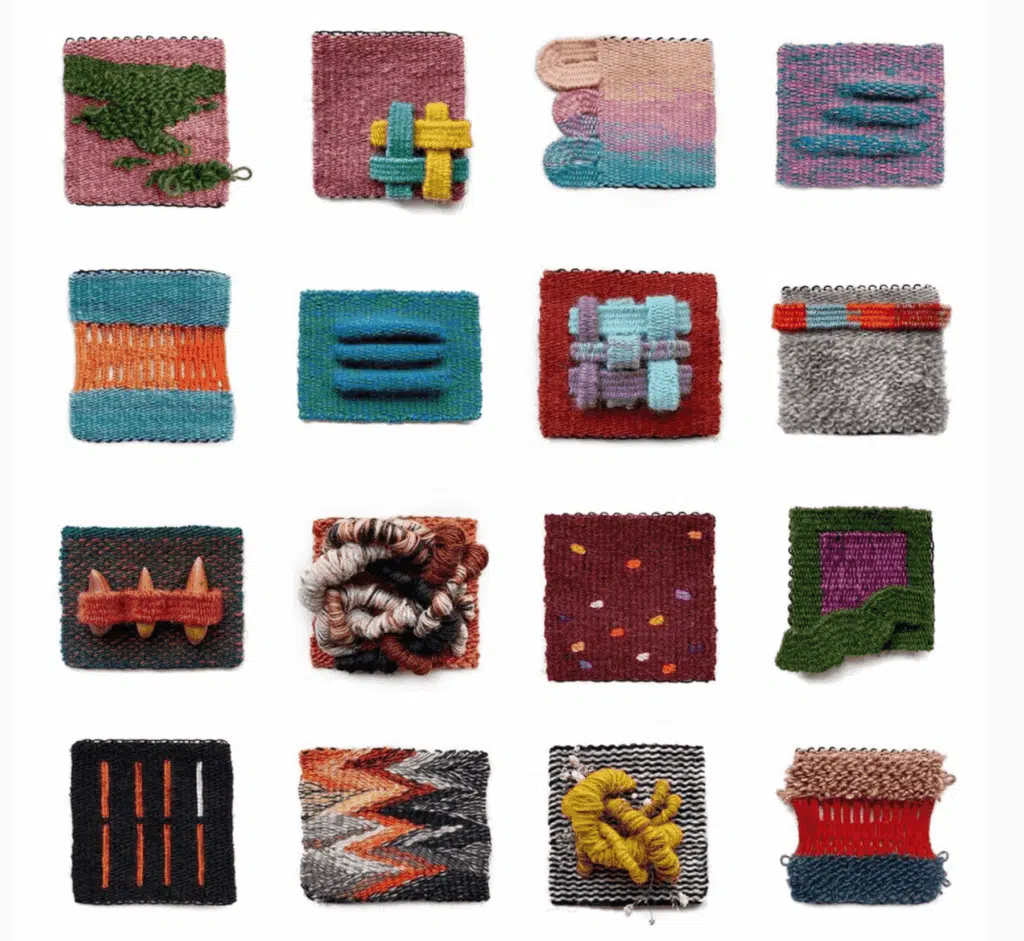
Natasha Khiev is a textile artist who approaches experimental weaving as a form of research. Rather than only making images on the loom, she experiments with structure, form and technique.
In her experimental weaving she often plays with the possibilities of the warp: the threads stretched tightly on the loom. By experimenting with those very threads, new structures and unexpected effects appear in the woven cloth.
A small change in warp tension or one extra thread can suddenly reveal a completely new structure. Those discoveries are exactly what make her work so fascinating.
What we love about our Mirrix ambassadors, and Natasha is one of them, is that each of them shows a different side of weaving.
Tapestry artist Liz Whiteside, another of our ambassadors, says it beautifully herself: Natasha’s work is very different from her own, and that is exactly the strength of it.
Liz takes you into painting with thread, from your first tapestry to small works you can frame. Natasha dives deeper into the technical possibilities of the cloth itself: warp play, supplemental warp, dimensional structures.
They truly complement one another. If you begin with Liz, Natasha feels like a natural next step.
👉 Also read: Collaboration with Liz Whiteside
Natasha often works on larger Mirrix looms, where the shedding device opens up new technical possibilities. That makes it easier to experiment with complex structures and build different layers within one weaving.
Liz works on the smaller Chloe looms, weaving detailed tapestry imagery. Two approaches, starting from the same instrument: the loom.
In her online lessons, Natasha shows you how to use the loom to experiment with structure and technique. Her approach is less about following a fixed pattern and more about exploring what is possible with thread and warp.
In the lessons, you discover for example:
Students who take a course with Natasha also receive 10% off a Mirrix loom. That way, you can get started right away with a high-quality and durable loom.
Warp play and supplemental warp are two terms you will encounter regularly in Natasha’s lessons. They may sound technical, but the idea behind them is actually very logical.
Warp play literally means playing with the warp. Normally, warp threads are simply the base: the threads held under tension that you weave over. In warp play, those threads become part of the design themselves. By shifting them, revealing them or combining them differently, surprising structures and visual effects appear.
With supplemental warp, you add extra warp threads on top of the existing cloth. That extra layer makes it possible to create new patterns, add relief or build multiple layers. It is a technique often used in experimental textile work.
Through her work, Natasha shows that weaving can be much more than making textiles. It can also be a way to investigate materials, structures and techniques, and to keep surprising yourself.
That is exactly why we are happy to have her among our Mirrix ambassadors. Her work shows just how versatile a loom can be.
Curious? Discover her work through her online channels:
Whether you are just beginning or already have some weaving experience, weaving never stops surprising you. Students of Natasha and Liz Whiteside both receive 10% off a Mirrix loom, so you can start right away with the right loom.
👉 Discover Natasha Khiev’s online lessons, such as:
👉 Would you rather begin with the basics? Start with Liz Whiteside’s beginner course.
Om de beste ervaringen te bieden, gebruiken wij technologieën zoals cookies om informatie over je apparaat op te slaan en/of te raadplegen. Door in te stemmen met deze technologieën kunnen wij gegevens zoals surfgedrag of unieke ID's op deze website verwerken. Als je geen toestemming geeft of jouw toestemming intrekt, kan dit een nadelige invloed hebben op bepaalde functies en mogelijkheden.